

Sweet, runny and blossomy, this dandelion honey is the perfect bee friendly vegan substitute for honey. If I hadn't made it myself I wouldn't believe it's not honey, it tastes and feels like the real thing!

The perfect vegan substitute for honey
Before I became vegan I didn't know much about honey production. So like many others I thought that buying honey was actually friendly to bees. I knew that vegans didn't eat honey, but I didn't really know the details why.
Made with foraged dandelion flowers, our vegan honey is so simple to make and tastes just like the real thing. All you need is fresh dandelion flowers, organic sugar, a lemon and water. That's it!
The dandelion flowers give this vegan honey substitute a rich floral taste. So, unlike other vegan honey alternatives such as golden syrup, agave syrup, date syrup, our vegan dandelion honey could make anyone believe it's actually honey!
Dandelions - Weeds or Wildflowers?
“A weed is but an unloved flower.”
Ella Wheeler Wilcox
Dandelions are considered weeds in the UK, often seen as the nemesis to those that want a perfectly green grass lawn. But dandelions have been used by humans for food for centuries and appreciated by many cultures for their medicinal benefits.
A dandelion is not just one plant, but several different species of the genus Taraxacum. The most common are T. officinale and T. erythrospermum and they spread across the world from Europe.
A dandelion is easily to recognise with it's bright yellow many petaled flowers. Its leaves form around the base, and often have a toothed leaves.
There are several similar plants with similar flowerheads in the daisy family Asteraceae, sometimes known as false dandelions, so learn how to distinguish these.

The leaf shape is what gives the dandelion it's name - from the French dent de lion, literally meaning lion's tooth. In German the plant is known as Löwenzahn (Löwe = lion, Zahn = tooth).
After they have flowered the plants turn into beautiful seed heads, often called clocks. Who remembers 'telling the time' as a child by blowing the seeds?

Eating Dandelions
Every part of the dandelion plant is edible. As always, with foraging be 100 percent sure that what you are gathering is correctly identified and safe to eat.
You can use the young leaves in salads and dry them to make tea. The long tap root can be dried, roasted and ground - it tastes surprising like coffee! Some people can have an allergic reaction to the pollen of dandelion, so take care.
The flowers can be used to make dandelion wine. But what we love to do most with the dandelion flowers, is to make this amazing vegan dandelion honey!
So let's get picking our flowers to make our vegan honey. Just leave some dandelions for the bees too 🙂

Picking Dandelion Flowers
The best place to pick your dandelion flowers is a lawn or field away from roads and dog walkers. Also take care not to pick anywhere that may have recently been sprayed with pesticides.
The flowers open during the day and close during the night. You want to pick the fully open flowers, that still look nice and fresh. For our vegan honey recipe, pick just the flower heads without any stalk.
Forage responsibly
Dandelion flowers are an important source of nectar for bees, wild bees and other pollinating insects. Especially early in the season, there are only few other plants these animals can feed on.
So please don't pick dandelions when you don't see many other flowers around. Instead, choose a time and place where dandelions are plentiful, and always make sure to leave an abundance of flowers for the bees. Your environment will thank you! <3
How to make it
Making our dandelion honey only takes a few ingredients and a bit of time.
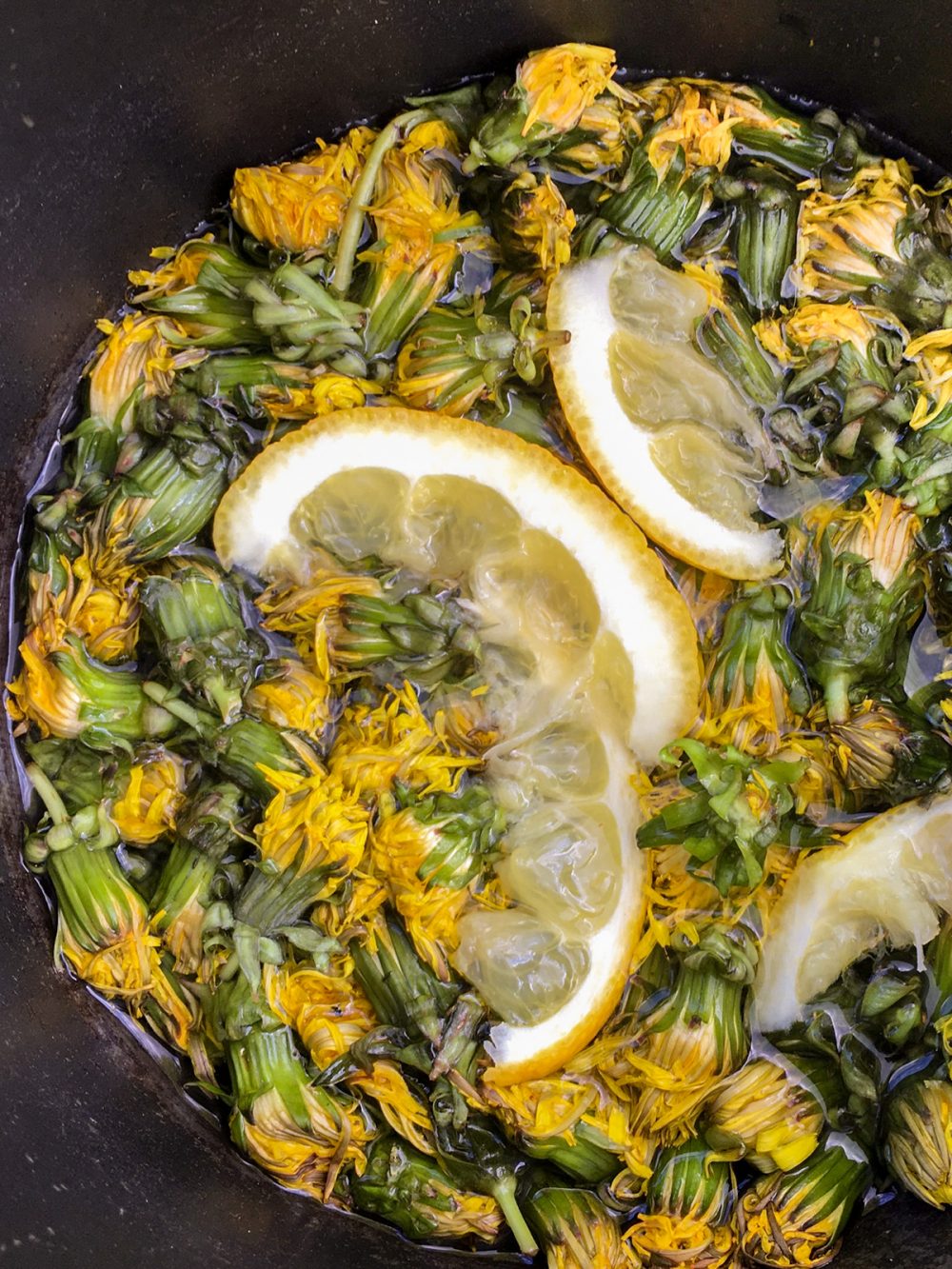
At first you make an infusion of the dandelion flowers with a bit of lemon, which needs to soak for several hours or overnight. Then you strain the liquid, add sugar in a 1:1 ratio and simmer it to thicken into a syrup. And just like that, your dandelion honey is ready!
In order to get the 1:1 weight ratio of liquid to sugar, weigh the liquid after straining, then add the same weight sugar. Alternatively, measure the liquid. One milliliter of the liquid weights one gram, or one fluid ounce weights one ounce.
At the end of the simmering, the hot dandelion honey should still be a bit thinner than the final vegan honey should be. It thickens up as it cools down, and might continue to do so after that.
We have detailed instructions, useful tips and some help for troubleshooting in the recipe card below!
Storing
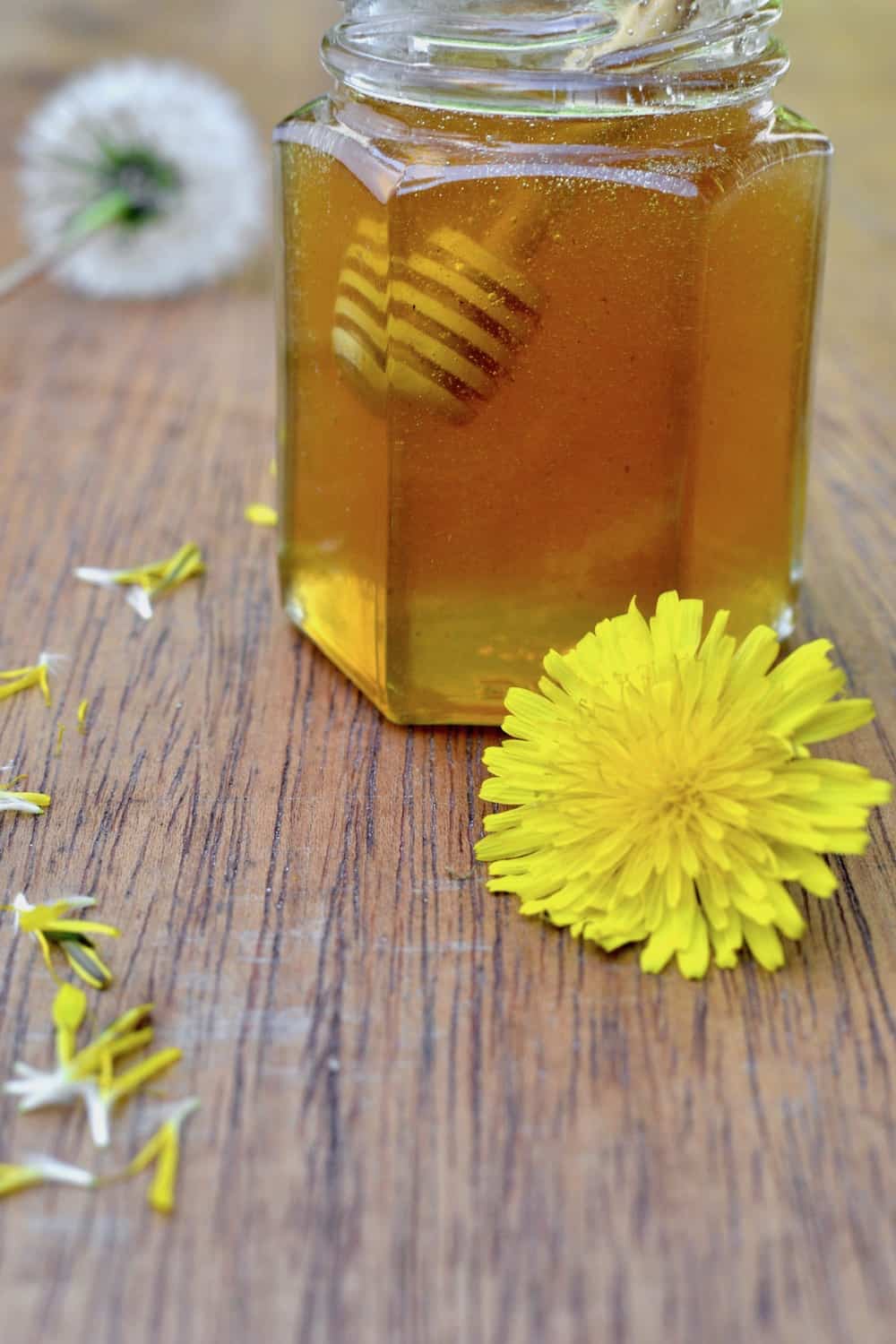
Fill your dandelion honey into small sterilised jars while it's still hot. Use clean tools. This way, the dandelion honey should keep at least a few months in a cool dark place. Hopefully it will last you until dandelions are in full bloom next year!
Like with jam, watch out for signs of spoilage or mold. Keep open jars in the fridge and always use a clean spoon when taking vegan honey out of the jar.
Using
You can use your dandelion ‘honey’ in many ways. Here’s a few ideas:
- Use it as a sweetener in hot drinks.
- Enjoy as a snack on some homemade sourdough bread and vegan butter.
- Mix with mustard to make a vegan honey mustard dressing.
- Drizzle over vegan pancakes as an alternative to maple syrup.
- Use in baking recipes such as cakes or flapjacks.
- You can also use it in place of sugar or syrup in sweet and sour and sticky sauces, like our Sticky Lemon Tofu.

We hope you like this dandelion honey as much as we do!
We really love foraging! You can find lots more wild food recipes and tips here:
📖 Recipe

Vegan Dandelion Honey
Ingredients
- 2 cups (100 g) fresh dandelion flowerheads, densely packed
- 2 slices lemon
- 1.5 cups (350 ml) water
- about 1.5 cups (300 g) organic sugar
Instructions
- Shake or blow the flowers to remove any bugs
- Place the water, lemon slices and dandelion flowers in a saucepan
- Simmer with a lid on for 15 minutes
- Leave this to cool and infuse overnight
- The next day, strain out the flowers and lemon by pouring the liquid through a strainer or muslin cloth. Press down to make sure you get all of that dandelion juice out!
- Weigh the liquid, and then weigh out the same amount sugar.
- Put the liquid back in the pan and add the sugar. Stir and heat gently at first until the sugar is dissolved. Then bring it up to a gentle boil for approximately 15 minutes. See the notes for tips on knowing when it's ready.
- Pour into clean sterilised jars and put the lids on while it's still hot
Notes
1:1 Liquid to Sugar Ratio
Ideally you want to weigh the amount of liquid that you have and use the same amount of sugar. We don't always have a scales to hand, so we use the cup measurements as above, and just use our judgement. As the amount of liquid you have left over after infusing the dandelions can vary, the sugar amount can vary, and so can the amount of time you need to boil the liquid. If you have ever made jam, it is a similar process.How to know when it has reached the right consistency
You will see that the liquid will darken and start to thicken. Test it regularly on a cold plate, or see how it clings onto a metal spoon. It will thicken more as it cools, so aim to turn it off before it reaches your desired texture. I prefer to stick to the more runny consistency. If you cook it for too long you risk that it gets overly thick and caramelises. You can also use a jam or candy thermometer to cook it until it reaches the thread stage at around 223 °F - 235 °F or 106 °C - 112 °C. If you change the batch size, the time needed to boil and thicken will vary. Just like real honey, this can also crystallise. But it's still good to eat.Picking dandelions
Always pick your dandelion flowers from a plentiful, clean and pesticide free place. Dandelions are an early nectar source for pollinators, so make sure to leave plenty behind for the bees and their friends!Troubleshooting
I haven't weighed the liquid
You can just use the measurements given in the recipe instead! In this case, however, cooking time until you reach the right consistency can vary. It might take a bit longer, or less long until you are done. Make sure to test the consistency as described above!I've added the sugar from the beginning
No worries! Nothing's lost. Here's what you can do: Instead of boiling for 15 minutes with the flowers at the beginning, just gently heat up until the sugar is dissolved, then leave to infuse overnight. To continue, strain the liquid as normal through a sieve, and the dissolved sugar stays in the liquid. Then heat up in a saucepan and simmer until the right consistency is reached (see tips above).My honey has crystallised
You have probably boiled off too much of the liquid or added more sugar than required, and the honey crystallised as it cooled down. Crystallisation can also happen when the vegan honey is stored for a longer amount of time.Nutrition
This information is calculated per serving and is an estimate only.
Haley says
I made mine with coconut sugar before I saw your warning about it and now it is SUPER runny…basically a liquid. Oops! Is there any way to salvage this to get it to thicken up?
Sophie and Paul says
Hi Haley, Oops, yes we don't recommend coconut sugar for this reason. Here's a couple of ideas you could try, but without testing it ourselves I'm not sure how well they will work so you may need to experiment. How sweet does it taste? Perhaps you add more regular sugar and perhaps a bit more lemon and cook it up again to thicken. Another common way to thicken runny jelly is to add pectin, this link might be useful if you want to try this method. You could also try making a cornstarch slurry, by mixing 1 tbsp cornstarch (cornflour in UK) with 1 tbsp water and whisk this into the liquid in a pan, bring to a boil and continue to cook for a couple of minutes and whisk as it thickens. It also does naturally thicken as it cools. Fingers crossed you can salvage it!
Haley says
Thank you for the suggestions! I’ll see what I can do…
Cheryl Stow says
Have you ever tried freezing flowers and making later in the season? Not sure if this would work, but have loads in my garden lol
Lisa says
i'm about to try it myself and hopefully will remember to come back and report. I also used stevia when i made this in the past and it was fine.
Jenny-lee says
Hello! I’m just about to make this and super excited! Would organic coconut sugar work the same?? I also have regular white sugar and regular brown sugar. Thanks 🙂
Sophie and Paul says
Hi Jenny-Lee! Coconut sugar is less dense and doesn't thicken in the same way so we don't recommend it. I'd use the regular white sugar for best results, but other readers have also made it with brown sugar with success. Have fun!
Lisa says
This recipe is my go-to! I follow it to the letter but during the 15 minutes it's simmering after the mixture is strained, I've added a few blueberries for a nice color. I've also added a bit of lavender flowers and even lilacs. I will try doing this with some violets and roses as well. I love infused honey. I have found that the honey thickens if your refrigerate it. if you cook it a little longer you get a nice jelly. it's a very versatile recipe. I've used other recipes where you remove all the green bits which is quite time consuming. I do not do this when using your recipe and there is absolutely no negative effect on the taste and it saves a lot of time. thank you for sharing!
Emma says
I followed the recipe to a T and my honey came out green. I was wondering if that was normal or not. When I strained it it was yellow but when i added the sugar it turned green.
Sophie and Paul says
Hi Emma, That's not something we have encountered before at home or from our other readers. Ours is always a yellow/ golden colour. What kind of sugar did you use, as perhaps that had an effect? What kind of bowls/pan did you use as it is also possible that some kind of reaction occurred with the cookware you used? We always use stainless steel.
Emma says
I used regular granulated sugar, a wooden spoon, and a stainless steel pot. I did have some of the green under layer petals of the dandelion in my pulp but when I strained it, it was a beautiful yellow and then turned ugly green when I added the sugar.
I have tasted it and it tastes delicious and just like you described above in the description.
Elaine Parkin says
Thank you for adding the note about leaving plenty of dandelions for the bees. I spoke to someone recently who had foraged 300 dandelions for honey! If everyone did that, there would be no source of early nectar. Bees are in dire straights and need all the help they can get, now more than ever, like all our wildlife. I haven't made honey yet, but would like to try. Even if I find a lot of dandelions I will make half the recipe - (I usually do this with recipes anyway.). Thanks again!
Sophie and Paul says
Thanks for minding the bees, Elaine! It's important to be thoughtful when foraging, and we do our best to point that out in any recipe posts where this is relevant. We make our vegan honey with dandelions from a field near our home that is full of uncountable dandelion flowers in early summer, and you don't see the difference after we're done picking.
As food for thought, various online sources suggest that to produce one jar of honey, bees have to visit about one million flowers to collect all the nectar (as a quick googling suggests)! Our vegan dandelion honey recipe uses just a tiny fraction of that. Much fewer flowers are needed, and no bees have to be exploited. <3 🙂
Philip says
If you pick a dandelion flower, the plant produces another one.
Suzy says
After sitting on the shelf, there are substantial crystals that have formed. It's still good to use, right? Can I just set it in a bowl of hot water to dissolve them? It tasted fine!
Mon says
Hi, thanks for the recipe. Quick question. The recipe calls for 2 slices of
Lemon or 2 sliced lemons?
Sophie and Paul says
Hi Mon, it's two slices of lemon. Hope you'll have fun with the recipe! 🙂
Suzy says
I never got a reply to this? According to the notes I may have boiled too long, or kept it too long, BUT can I still use it? I can't wait until the they bloom this year to make more! Thanks!
Sophie and Paul says
Hi Suzy, apologies we must have missed it! It should be fine if it just has formed crystals (and shows no signs of mold). You can add some boiling water to the jar to dissolve the crystals and then boil it again. If it has completely crystallised and won't come out, try placing the jar in a hot water bath to dissolve the crystals. Have fun making more soon and this time try cooking for slightly less time. We still have a jar of last years in the fridge that is still perfect consistency.
juniper says
Absolutely delicious!! Thank you for this lovely recipe. I had so much fun picking dandelions with my kids.
Fiona says
i had an abundance of dandelions and wanted to give this recipe a try, I was not disappointed and even my other half who is a beekeeper enjoyed it. I did feel I was doing some tiny bugs out of their homes as I blew them away though! Delicious
Teri Osborne-gomez says
Just amazing - just like honey. Plus the health benefits of any part of the dandelion plant are numerous!
Sophie and Paul says
Thanks so much Teri, delighted you loved it!
Jamie says
Hi I made this and put them in my jars but they been sitting and their runny. How do I fix this?
Sophie and Paul says
Hi Jamie,
you can put it back in a saucepan and simmer down a bit more. Put a few small plates in the freezer beforehand, and to test if the vegan honey is thickening up, put a little bit on one of the cold plates. That way you can test the consistency when it cools down. Hope this helps!
Jenny says
Made a batch exactly as you wrote and it's was delicious and set perfect. The huge batch I then made is still a little runny in the jars after being left overnight (still tastes amazing though), have you ever tried re-boiling the honey the day after? I'd already boiled for a almost an hour. Thanks 🙂
Sophie and Paul says
Hi Jenny, we've reboiled it in the past and there's no problem with doing so. Larger batches naturally need longer boiling to get to the same consistency. It's all about how it sets, not about exact time 🙂 So glad you enjoy our recipe! xx S&P
Veeny says
Made this today, was runny at first, now crystalised, how can I make the honey runny again?
Sophie and Paul says
Hi Veeny,
this can happen when you boil it down a bit too much. Add some boiling water to the jar to dissolve the crystals. If it has completely crystallised and won't get out, try placing the jar in a hot water bath to dissolve the crystals. Once everything's back in the saucepan with the extra bit of water, repeat the simmering, but stop earlier than last time so it won't crystallise again. Hope this helps! Let us know how you get on 🙂 Good luck <3
Veeny says
Thank you, will try your suggestion and get back to you.
Carmel says
This turned out so delicious... I was concerned that it looked a bit murky and white froth formed at the top but it boiled out lovely and clear. About to make another jar 😋
Sophie and Paul says
Awesome, Carmel! 🙂 Perhaps we'll add a note about the froth in the post, so thanks for the comment! Enjoy your vegan honey 🙂
Belinda Jarvie says
My Nanna used dandelions all the time. Saw your recipe.....the rest is history. Love this!! In my tea, on toast....trying with oranges in my next batch... delicious!
Sophie and Paul says
Yay, how nice that you are carrying on the family tradition by using dandelions. Enjoy the orange batch! 🙂
Brenda says
There are different kinds of dandelions how do I know I am picking the rite kind?? How do I identify the rite ones ?
Sophie and Paul says
Hi Brenda, look carefully at any wild plants to examine all their features to help you to identify them and never eat something if you are not 100% sure. This a handy guide for dandelions in the UK, which also lists similar looking plants. https://www.wildfooduk.com/edible-wild-plants/dandelion/
Maggie M says
I made a 4x batch yesterday and blind taste tested my husband. He said it tasted just like honey!
I did another batch with a touch of natural vanilla and it added a nice creamy taste.
Today, I'm boiling down a batch with chamomile for a sweeter taste, and one with lavender for tea. They are on the stove now and smell AMAZING! Thank you for this recipe!!
Sophie and Paul says
That's fantastic to hear Maggie! Thanks for your wonderful feedback and so glad it passed the taste test with great success. Loving your variations too - they all sound delicious!
Carole Banton says
Hi
I made the dandelion honey today!
Delicious!
Are there other edible flowers I could use to make it later in the year?
Thanks
Carole
Sophie and Paul says
Hi Carole, We've also made it with false acacia/black locust flowers and elderflowers. But dandelion gives the most honey like flavour we've found. You could try other a mix of other edible blossoms such as chamomile, rose, lavender. You might also like to try freezing some dandelions to make a batch later in the year. Glad you enjoyed it so much! 🙂
Shayne says
I actually stopped supporting honey because honey bees are an invasive species here in North America and terrible for the ecosystem. This is an awesome way to make European and Asian recipes that require honey without supporting an industry that destroys our beautiful native bee species!
Susan Campagnola says
I was very intrigued by your bee-free honey. Please remember that dandelions are a vital source of nectar for bees when other sources are not available. Make your honey when there are plenty of other sources for the bees. I was a beekeeper for 17 years.
Sophie and Paul says
Hi Susan, Thanks so much for your comment! We do specifically mention in the recipe that dandelions are an important early nectar source for bees and not to over pick. I will try and make it more prominent. We personally make ours when there's lots of flowering sources around our area, and recommend our readers to do the same.
Courtney says
Love, love, love! Thanks for sharing this recipe. Life changing. I have been eating on my first batch for about a month now and the bottom of the jar has crystallized just recently. Any tips or tricks on how to liquify this again?
Sophie and Paul says
Hey Courtney, glad you love it so much! 🙂
What I've done before is reheat it to melt the sugar crystals. Pour a bit of boiling water in the jar to detach crystals that stick firmly to the jar. Boil it down again to get rid of the additional water if you add any. Hope that helps! 🙂
Enjoy your dandelion honey! Love, Paul & Sophie