


The most refreshing drink. Ever! Heavenly flowery and tangy. Our homemade elderflower cordial is perfect with sparkling water on a summer day.

Every spring we make a huge batch of this elderflower cordial to last us the whole year. The ritual of picking elderflowers and filling the house (or our campervan) with their blossomy scent is a tradition that celebrates spring.
Homemade elderflower cordial is much tastier than store bought. This cordial is more tangy and floral, and less syrupy sweet. And it’s such a fun thing to make. (It’s always great fun to make things with edible flowers - like our vegan dandelion honey!)
Making your own cordial will save you a load of money too! In the UK, one 500ml bottle will set you back around £3, whereas making a batch of this cordial costs less than that - for 6 times as much!
Picking elderflowers
Elderflowers are the edible blossoms of the Elder tree, Sambucus nigra. This small tree is native to Europe and North America. It blossoms in late spring, and produces dark berries in late summer. Elderberries are also edible, but must be cooked before eating to get rid of toxins.

Here’s our top tips for picking your own elderflowers:
- Avoid picking from roadsides and polluted areas
- Individual flower heads are at their prime for picking when the little flowers have fully opened and have not started to wilt or turn brown.
- The best time to pick elderflowers is late morning on a dry day.
- The flowers should smell blossomy and sweet - watch out for a slightly unpleasant aroma the flowers might develop in the afternoon, or when they are past their best.
- Always use them as soon as possible after picking.

Citric acid
Citric acid is a preservative and is naturally found in lemons and other citrus fruits. It brings a lot of tang! to the cordial and has a role in extracting the flavour from the elderflowers. It’s also what helps the cordial to preserve for so long.
Where to get citric acid
It can sometimes be a bit tricky to find – pharmacies and world food shops are a good place to look. Our local zero waste shop sells it, so we buy it from them. It’s also easily ordered online, just look for food grade quality. We recommend organic citric acid which is GMO free.
Making cordial without citric acid
It is possible to make this elderflower cordial without the citric acid, but the taste will be different and the cordial won’t keep so well. If you omit the citric acid, store the finished cordial in the fridge and use up within a few weeks. You can also freeze it in plastic bottles so there’s room for expansion, or in ice cube trays.
But if you can, we highly recommend using the citric acid in this recipe. To us, it makes all the difference!

Step by step
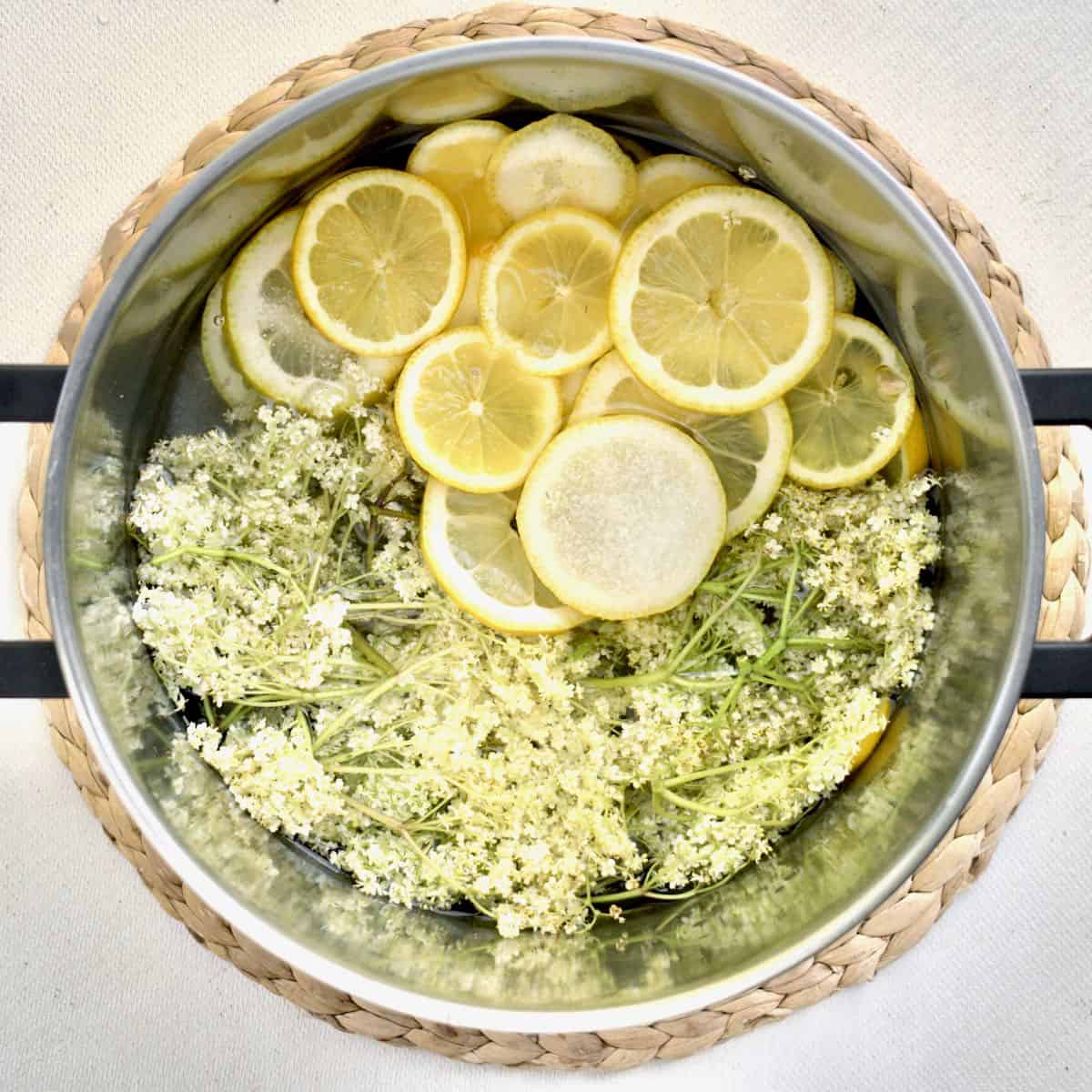
STEP 1 - Add water, elderflowers, sliced lemons and citric acid to a pan and bring to boiling point.

STEP 2 - Remove from heat and leave to infuse for a few hours or overnight.

STEP 3 - Strain the liquid through a muslin cloth or fine sieve.

STEP 4 - Return the liquid to the pan and add the sugar.

STEP 5 - Bring to boil, stirring frequently to dissolve the sugar. Simmer for 5 minutes.

STEP 6 - Fill the cordial into clean, sterilised bottles while still hot.
Preserving and storage tips
Here’s our advice for how to make sure your elderflower cordial will keep well:
- The final boiling step sterilises the cordial by killing off any wild yeasts, bacteria or spores that will cause it to spoil.
- Clean all your glass bottles, lids and other equipment in soapy water or in the dishwasher, then fill with boiling water. Leave for 5 minutes before draining.
- Alternatively, place the washed bottles and lids in an oven at 140˚C until dry.
- Fill your bottles and put on the lids as soon as you finish simmering and the cordial is still hot. (Wear oven gloves as the bottles and lids will get hot!)
- Bottling whilst hot ensures that the lid seals as the liquid cools.
Store unopened bottles of cordial in a cool and dark place. After opening, keep in the fridge.
More tasty elderflower recipes
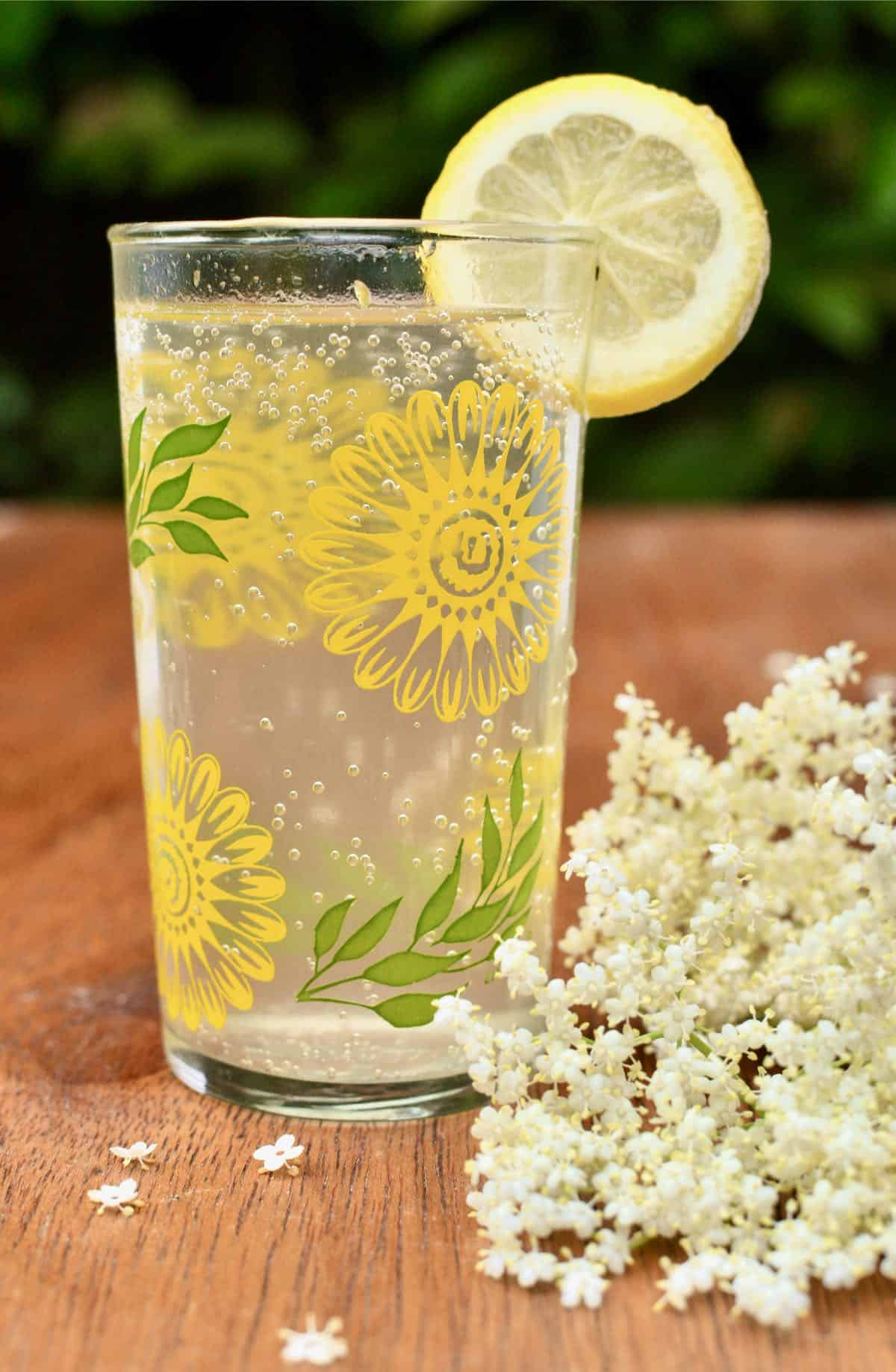
Our homemade elderflower cordial makes a perfect summer drink when mixed with cold sparkling mineral water. It also adds a fresh and fruity note to a glass of wine, champagne or a cocktail.

But you can use elderflower cordial for other things than just drinks... Try our other elderflower recipes:
Elderflower Cake
Elderflower and Coconut Ice Cream
Elderflower and Lemon Ice Lollies
Elderflower Fritters
Enjoy the summer!
Paul & Sophie
📖 Recipe

Easy Elderflower Cordial
Ingredients
- 15 elderflower heads large (use double if small)
- 2 lemons sliced
- ¼ cup (50 g) citric acid
- 2 ½ litres (2.5 litres) water
- 5 cups (1 kg) sugar
Instructions
- Check elderflowers for dirt and little insects - don't wash!
- Add elderflowers, lemon slices and citric acid to the water in a big pan. (The only ingredient not yet going in is the sugar)
- Heat up to boiling point, stirring occasionally, remove from heat, cover and let infuse overnight, or for at least four hours.
- Strain the liquid through a muslin cloth, to catch all the flowers. Squeeze all that yummy flavour out of the pulp in the muslin!
- Return liquid to the pan and add the sugar.
- Bring to boil again, stirring frequently to dissolve all the sugar, and simmer for 5 minutes.
- In the meantime, clean and sterilise all your glass bottles, lids, a funnel and any other equipment in soapy water. Rinse the bottles and fill them with boiling water and leave for 5 minutes before draining. Alternatively, place the washed bottles and lids in an oven at 140˚C until dry.
- Bottle up the finished cordial while it's still hot, pouring carefully into your warm bottles and closing the lids.
Dilution
- Depending on desired sweetness, dilute 1:5 to 1:10.
- Best enjoyed with sparkling mineral water.
- Optional: Squeeze in some fresh lemon for extra tanginess!
Notes
Nutrition
This information is calculated per serving and is an estimate only.
Anna says
Elderflowers don't grow where I live, as far as I know in Alberta Canada. I found dried elderflowers in the health food store. Can I use that instead?
Sophie and Paul says
Hi Anna, Yes it looks like elderflowers aren't native to Alberta. We haven't tried the recipe with dried flowers, but I did a bit of research and people have had success with using dried, though I imagine the flavour is a little different. Do let us know if you give it a go! Sophie 🙂
Amelia says
Hi Anna
Did you make this with dried flowers in the end? If so what weight did you use please?
I made this with fresh flowers but it went too quickly as everyone loved it. Now the season has past I’ve bought dried flowers to try to carry us through to next year! I’ll definitely harvest more next season and make more!
Sophie and Paul says
Hi Amelia! So glad you loved the cordial, it does disappear fast doesn't it! I don't know if Anna tried it with dry, but I did a bit of research and sources seem to suggest trying approximately 25-50g dried elderflowers for 3 litres of cordial. Not sure if the taste will be quite as good as fresh but we cross our fingers that it works for you. Do keep us updated if you try it 🙂 Sophie
Amelia says
Thanks Sophie, will give it a whirl and let you know! I’m not expecting it to be as good as fresh but something at least! Many thanks
Sharon Wieczorek says
I am interested in making this without the lemon, so as to have only the taste of pure elderflower. Would that work for this recipe? Do you have any specific pointers or feedback regarding omitting the lemon?
Sophie and Paul says
Hi Sharon, We've always made it the traditional way using lemon. I would simply try leaving it out and seeing how it tastes. The citric acid itself also has a tangy flavour (which we really like) but if that's what you are keen to avoid, then you could try leaving it out. Though we've found the citric acid helps to extract the elderflowery flavour as well as extending shelf life. Have fun experimenting!
Rachel says
I'm furloughed at the moment and have wanted to make some cordial for ages but never had the time, got elderflower champagne on the go and now giving your cordial a go so I'm hoping it comes out great! The recipe is very easy to follow just had to convert the cups into grams. Might have a go at elderberry wine?!
Sophie and Paul says
Hi Rachel,
hope you are managing well in these weird times. Glad you find some joy in these projects! 🙂
You will find we actually have a conversion tool integrated into the recipe. Just above the ingredients, you can switch between 'US cups' and 'metric'. We've weighed and measured everything ourselves, so these metric values are 100% reliable! 🙂
Hope this helps, enjoy making the cordial!
Best wishes, Paul
Siobhan says
Absolutely delicious! Made a batch yesterday and had the first try today. Thank you so much for the recipe.
I will be making this every year from now on.
Buzz says
Love 💕 this, just made a batch of 4 litres. Very easy to follow & not as much sugar as some recipes (2.5 ltr 😳) the wine bottles work a treat & it’s smell & taste are delicious!! Hello Summer 🌞
Stevie B says
Just picked some elderflowers in the local park (bit late in the day - but thought I would give it a go anyways as the flower heads bouquet is the typical heady floral elderflower - scrumptious - thanks
Sophie and Paul says
You're welcome, Stevie! As long as the flowers stand the bouquet test, that's absolutely fine. 🙂 Enjoy your cordial!
Patricia says
I am a very old cook ,in every sense of the word, and have been making elderflower cordial for many years. This year,however,I took your advice and added citric acid. The difference in flavour is astonishing,so much more 'tang'. My daughter was raised on it. She is now 40years old and has declared this a vintage year! Thankyou so much.
Kindest regards Patricia.
Sophie and Paul says
Thank you Patricia, so happy you enjoyed another of our recipes! This one is an adaptation of my grandma's recipe, I just changed the process a little so I don't have to use a preservative. I, too, was raised on it, and this is the only type of elderflower cordial that has ever done it for me. Glad that you and your daughter approve of it as well. I'll tell my grandma 🙂
Enjoy and best wishes, Paul
TT says
Made Elderflower Cordial from your recipe for the first time ever. It was very yum... Agreed about the less amount of sugar. bonus!!! I also halved the amounts, as I didn't want as much... came out lovely!
Sophie and Paul says
Thanks TT! We really love that this Elderflower Cordial is more on the tang side rather than the sweet!
We've tried other homemade and shop-bought elderflower cordials, and Paul never really likes any of them. This is the one and only to us!
Hope you have enough to get through the summer. Our supply is already dwindling 🙂
All the best, S&P
Hayley says
Hi quick question about this one. I have been saving bottles to use for this instead of buying them. Can I wait until cooled a little so I can use plastic ones? Also do you know if using old red wine bottles would be ok?
Sophie and Paul says
We've never used plastic bottles before for making our own Cordial, because we can't sterilise them as well. Letting the cordial cool down before bottling increases the chance of unwanted fermentation or mold. In other words, it will not keep so well. I would suggest in this case keep to keep the cordial it in the fridge, or for longer storing times plastic bottles can be frozen.
Wine bottles are excellent when they are washed well and sterilised with boiling water. We only use screwtops, but I assume that sterilising cork stoppers could work as well.
Hope this helps! Good luck, Paul
Hayley Murray says
Thankyou for answering! The wine bottles I have are screw top ones so that should be fine but I haven’t got enough. Will keep the plastic ones in the fridge. I am planning to use Milton Fluid to sterilise every bottle I use.
Sophie and Paul says
That's great! Oh and also, keep the cordial covered with a lid as it cools down, then use a sterilised ladle and/or funnel to bottle it up. That will also help keeping contamination to a minimum. If you have a lot of bottles for the fridge, I suggest you freeze some of them instead.
Paul
Bernie says
Hiya ,
Can I make it without citric acid then add the citric acid when it arrives in the post in about 2 days?
Thanks
Bernie
Sophie and Paul says
Hey Bernie, We haven't tried it ourselves but I think it should work out. I'd keep it refrigerated in the meantime and simmer for 5 mins with the citric acid just before filling into sterilised bottles. The other thing you could do is to freeze the elderflowers and wait until your citric acid arrives to starting making it. Hope that helps! Sophie
Lynn says
Great recipe. My first batch is now in bottles. The whole house smells wonderful. Thank you for the easy instructions. I look forward to enjoying this delicious cordial with my family and friends.
Sophie and Paul says
Thanks so much Lynn! The smell when making it is one of our favourite things about this time of year! Enjoy it 🙂 Sophie
Sarah says
Mine seems to be quite a bit darker though. To be fair I've not tasted it yet as it's still cooling down but its definitely no where near a light in colour as yours. I'll just keep my fingers crossed I think!
Sophie and Paul says
Hi Sarah, glad you find our recipe easy to follow!
Did you perhaps use golden or brown sugar? If not, then it could simiply be a natural reaction of the flowers with the water. Definitely do a taste test if you want to be sure it's alright. Crossing our fingers with you!
Sarah says
Thanks, I have done a taste test and it was lovely so I feel less worried that I am accidentally going to poison everyone now. There is a bit of sediment looking stuff at the bottom of the bottles this morning but it disappears fully when I shook them so I'm assuming all of this is just part of making things from scratch yourself instead of processed supermarket things. Thank you so much for the recipe, my son has his eye on the Dandelion Honey next though.
Sophie and Paul says
Great! So glad it turned out a success 🙂
The sediment is pollen from the flowers. It is totally harmless and will normally just stay in the bottom of the bottle though at the end, it might make the drink a bit cloudy (which still doesn't do any harm).
Good luck with the dandelion honey! That one's also very popular.
Lots of love,
Sophie & Paul
Sarah says
I have my first ever batch on the stove top as we speak. Having always wanted to try it, I have been put off by how complicated other recipes sounded but this seemed like a complete beginner would have a chance at producing something drinkable. Keeping everything crossed!!!
Jill Burgess says
After promising to make some for years at last I have done it. What I liked about your recipe was there was less sugar than others I looked at.
Passed with great approval by friends last evening- the remaining bottles are in cool garage. many thanks Jill
Sophie and Paul says
So glad you finally did it Jill! Totally agree with you about the amount of sugar, I always found other recipes too syrupy sweet whereas this has a lovely floral and citrusy tang to it. Thanks so much for using our recipe 🙂 Sophie
Nika says
Thank you for inspiration. Will it work with brown sugar?
Sophie and Paul says
Hi Nika, You're so welcome 🙂 We recommend white granulated sugar, but another reader had success with brown sugar. You may find that the caramel flavour of darker sugar will overpower the delicate flavour of the elderflowers. Hope that helps! Sophie
Judith says
Many thanks for the easy-to-follow recipe. I have my first ever batch of elderflower cordial steeping as I write this so fingers crossed! I have used citric acid to preserve the cordial. Keeping the bottles in a cool, dark place how long is its shelf life? I see that it needs refrigerating once opened but wondered how long I could store it unopened?
Sophie and Paul says
Hi Judith,
Thanks so much, we hope you enjoy your first batch! We've only just now finished up last year's batch which was absolute fine. As long as you are careful to sterilise everything very well, and boil it properly it keeps for up to a year in a cool dark place. Signs that it is no good anymore would be fermentation or mold. You may see a bit of pollen rich sediment, but that is normal. You can also keep the cordial in the freezer, in which case freeze in plastic bottles to allow for expansion. Enjoy!
Sophie
Sharron says
Thankyou - great recipe and all tuned out well - enjoyed the picking with the family
Stella Picken says
What does the mould look like? I've followed the boiling and steralisation process but have white bits floating in the bottles. This is now 6 weeks after making. I had added citric acid to aid the storage time, and kept them in the fridge in sealed preservative bottles. But not sure whether this is now mould or a natural sediment. I just started drinking some cordial which tasted fabulous but then noticed the floating white bits. So have thrown this away. Can you help?
Sophie and Paul says
Hi Stella, It's normal that there is some natural sedimentation from the elderflower pollen. This typically looks fine and yellowish and sinks to the bottom of the bottle, and you may only notice it a while after it's bottled. Mould typically grows on the surface, and would be more blue/white. I'd be surprised this was the case as you mentioned you'd done all the boiling/sterilising/citric acid etc, but things can still get accidentally contaminated. The other possible (but unlikely cause) could be fermentation and the white bits could be yeast growing, in which case you might be able to smell a yeasty scent/see bubbles. In this case it would still be ok to drink, but you'd need to release the gas from the bottles even few days as it would be turning mildly alcoholic into elderflower champagne. Hope this info helps, without seeing the cordial in person it's difficult to advise you, but we hope that it turns out to be alright. Do feel free to email us a picture and more details if we can help further.
Stella says
Thank you so much for quick your response. I will keep this info for the future. I've also read that people sometimes boil the full bottles in a water bath to pasteurise. Wondered if you'd tried this ? I've thrown it away and will use up the frozen cordial and try again next year. Thank you again.
Sophie and Paul says
Stella, we haven't found it neccessary to do this as our cordial has always kept for years without.
If you have everything you need for water bath pasteurisation, then go ahead and give it a go, can't hurt! 🙂
Sarah says
Picking elderflower and then making a batch of cordial is a really lovely way to spend a sunny afternoon. The bottles of cordial also make great gifts. I hadn't made it before but this recipe turned out perfectly! Thank you so much x
Sophie and Paul says
Thank you Sarah, that's so lovely! Enjoy your perfect elderflower cordial!
Love, Sophie & Paul
Elaine says
Wonderful recipe simple and very yummy 😋
Thanks
Sophie and Paul says
Yay! So glad you like it, Elaine!
Jo says
Just made some and it is wonderful. I was very “informal” with the ingredients and measurements - added orange as didn’t have 2 lemons, and used up a mixture of sugars from my cupboard (dark brown sugar, coconut sugar, Xylitol), and then added some vegan dandelion honey that was more runny than I’d wanted. The result is quite dark looking, but no less tasty.
Thanks for such an easy and adaptable recipe.
Sophie and Paul says
Thanks so much Jo - We're delighted you enjoyed it! Sounds like it was a great way to use up those odds and ends in your cupboard 🙂
F says
What a wonderful recipe! Just mad a batch and it tastes amazing!
Sophie and Paul says
Ooh thanks so much! We're delighted you like it. It's one of our absolute favourite things to make - we've already done one batch this year, but are gonna have to make some more again soon. Sophie 🙂
Sarah says
How much did this make please?
Sophie and Paul says
Hi Sarah, The recipe makes around 3 litres of cordial. In the recipe card there is a serving adjustment where you can change the batch size to suit you.